The Formation Of Baseball in the Bahamas: The Commencement of Organized Baseball in the Bahamas

The Formation Of Baseball in the Bahamas: The Commencement of Organized Baseball in the Bahamas
The Formation Of Baseball in the Bahamas:
Prior to 1954, the game of baseball was first played in the Bahamas when Mr. David Ferguson would go out to the American naval ships tied up in Nassau Harbor and bring the sailors to play against young Bahamian ballplayers. Games were played at the Southern Recreation Grounds, also known as “The Government Grounds.” In early 1954, a visiting Canadian schoolteacher named Harry Joynes saw the raw athletic talent of Andre Rodgers and recommended him to the National League’s New York Giants for a tryout for their professional baseball organization. This gesture of confidence in his ability, on Mr. Joynes’s, was made even though Andre had never played the game of baseball. Andre succeeded in the try-out and was signed a contract to play for the Giants that year, becoming the first Bahamian to play professional baseball, then regarded as America’s favorite pastime. His success led to the formation of the Bahamas Baseball Association (BBA) in late 1954. The first official grouping for the formation of baseball in the Bahamas was on Wednesday, August 28, 1954, and was named the Bahamas Baseball Association. The meeting took place in the old Y.M.C.A building on Cockburn Street in the historic area of Nassau, known as Grants Town. Hence, this was the beginning of Organized Baseball.
The Formation of the BBA:
The Association’s first founding members were the Southern Eagles Baseball Team, the Winnie Ann Reds, the Amateur Athletics Association, and the Western Sporting Club. Mr. E. S. Stanley Mitchell was elected President, and Mr. Reno Brown was elected Secretary. They were regarded as pioneers of Baseball in the Bahamas. The other initial officers were Mr. Joseph Moses, First Vice President, and last but not least, Mr. George Gardiner, Treasurer. All in all, these four men formed a great Executive team, all working together and striving for one main objective. The games were played on Clifford Park in November 1954. Joining the league were the Westerns, Blue Sox, Falcons, Amateur Athletics, Jets, Southern Eagles, Ahepa, Braves, Comets, St Bernard’s, and Cee Bees. As mentioned earlier, Mr. E. S. Mitchell and Mr. Reno Brown were the two individuals who were primarily instrumental in the organization of baseball and in its continued success since that historic day in August 1954. The Falcons won the first championship.
International Tournament Play:
In 1957, the Bahamas Baseball Association became a member of the National Baseball Congress of America. The N.B.C. had a Global Baseball Program that covered all the Countries in the World. This Association has helped the Bahamas in countless ways to improve the standard of baseball played here. The Bahamas Baseball Association elected Mr. Harry Joynes as their first Official Representative to the National Baseball Congress. Subsequently, he was appointed as the Commissioner of Baseball for the Bahamas by the National Baseball Congress. Being a member of the N.B.C. allowed the Bahamian teams to participate in the N.B.C.’s sponsored Global World Series. This was usually held in the United States, and competing teams came from all over the World. Commissioner Joynes decided that every effort possible would be made to send a team from the Bahamas to the Global World Series. The players were selected from the teams in the league based on their performances during the season. The season ended early in the summer, and approximately 25 of the best players in the league were selected and trained for about one month before the series was to travel. The final squad was 16 players, which was the maximum number of players any team’s roster could have.
Paid Umpires:
In 1958, the Association took major steps towards improving the standard of play of baseball in the Bahamas. Under the supervision of the Commissioner, the Association employed Salaried Umpires for the very first time. The first such umpires were Tex Lunn, Bernard Millar, Dennis Fernander, Sidney Wilson, and Kenneth Francis. Their standard of work was good, and each season, they gained more and more experience under their belts. Each year, there was no doubt that the standard and quality of Umpiring in the Bahamas showed considerable improvement.
All Umpires showed enthusiasm, eagerness, willingness, and punctuality in their umpiring and were undoubtedly a definite credit to the Association. One of the greatest drawbacks to good baseball in the Bahamas has always been the lack of adequate playing facilities.
The First Baseball Venue:
All the BBA games were played at Clifford Park, and although the grounds were good, it was not quite large enough for a regular-sized baseball park, at least by international standards. Now, all the games was played during the day time as there were no lights for night games, and Because there were no bleachers that created another major problem in those days, because it was impossible to keep the many spectators adequately separated from the players and This proved to be a major problem whenever there were controversial calls and placed extra burden and responsibilities on the umpires.
Finally, Regular Size Diamond:
In 1966, all of that changed when the league finally made the move to a brand new regulation-sized diamond with bleachers, press box, and concession areas at the Queen Elizabeth Sports Center. The move was good for the sport of baseball, with bigger and better facilities with more seating and the separation of the spectators from the players, and the Umpires had better control of the games. Also, with the move, the league was able to add more regular-season games, but was still somewhat in the same format. Only this time, car races forced the postponement of games.
Heading to Wichita, Kansas:
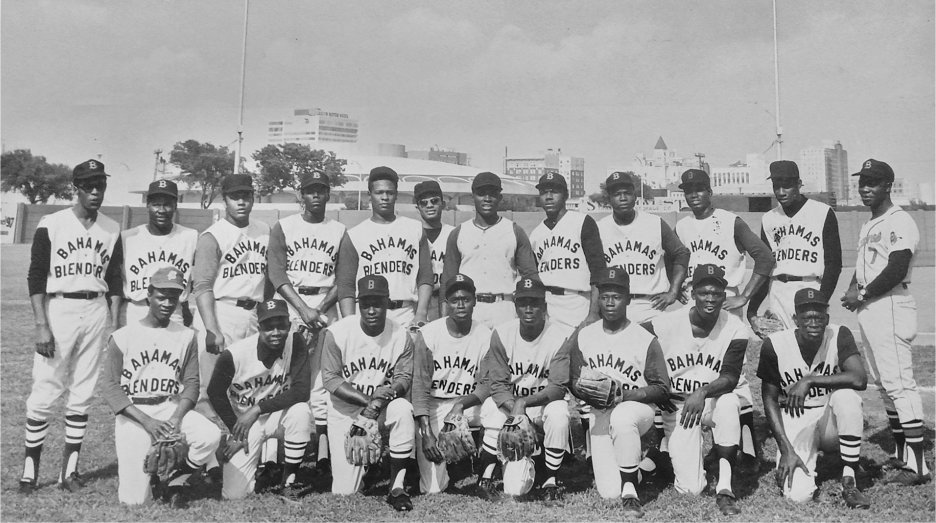
With the first-class diamond, the BBA now thirsted for foreign competition and in 1967 sent a squad to Florida to compete with National Baseball Congress area teams to earn the right to compete in the annual Wichita tournament. The all-star made up mostly of I-Need-A-Laundry players (Adrian Rodgers, the standout player) made a great showing, thereby qualifying for a Wichita invitation. Each year, the BBA sent a team to that tournament from 1967 to 1974. The BBA broke its losing streak in 1968 by winning one game before being eliminated. Sherwin “Sea egg” Taylor got the win in relief.
In 1969, under the guidance of Skipper Vince Ferguson, the Bahamas had their best-ever showing on foreign soil, winning 3 games and placing seventh among the power-houses of Amateur United States Teams. Frankie “Cinderella” Sweeting was the hero of the series, winning 3 games and placing him forever in the National Baseball Congress record books. The team batted over .400 in the tournament, placing two players, Sidney “Butts” Outten and Eddie Ford, on the All-NBC squad. Since 1969, however, BBA’s fortunes in Wichita went steadily downhill, and in 1974, a resolution was made to never again compete in Wichita.
Antony Tony Curry became the President:
In 1970, Antony Tony Curry became the President of the Bahamas Baseball Association. In October of that year, it was not a job that Tony wanted. It was not that Tony did not want to devote his efforts towards the continued growth of the sport of baseball in the Bahamas; he had other ideas on how best he would make his contribution. Only two years earlier, he was still an active professional baseball player. He felt that he could best make a contribution towards the game through playing in the local league, but his close friends encouraged Tony to run for the top job in the association, and he won easily.
It has been almost three years since Tony took over the B.B.A. Plus, in this short period of time, the association’s action has grown from strength to strength. Tony’s job was to set a policy designed to improve the caliber of baseball played in the Bahamas. The Bahamas had, in previous years, competed in the National Baseball Congress Tournament in Wichita, Kansas, and, except in 1969, performed poorly. But when Tony took over, he immediately made it known that the association wButd cease to sponsor a team in the Wichita Tournament until the caliber of play locally had been improved, as far as the tournament in Wichita is concern he did not feel that it help our situation very much because of the short schedule which we had at the time to compete in such a tournament, I felt we needed to play more games in our local season.
President Tony Curry’s New Vision of Night Games:
One of Tony’s Vision for the game was to greatly increase the schedule which he said was a part of his overall programme he said “ I could not see any room for improvement in a league that plays a 12 or 14 game schedule, what we founded ourselves doing was playing once a week or every other week and one could not really improve their play because anything one grasped was lost in the interim period of inactivity. Because he believed that the increased activity was one sure way to improve the game, Tony and his team of officers left no stone unturned in their efforts to have the LIGHTS TURNED ON at the Queen Elizabeth Sports Center, the light poles had been sitting there for some reason or another other but they were never turned ON.
Returning to Withita, Kansas:
And the 1972 schedule was increased to 38 games per team that season, each team played a total of 52 games. Now that the local players are being fed a steady diet of baseball, Tony Curry has set his sights on the Bahamas once again, entering a team in the Wichita Tournament. As a matter of fact, the BBA President was confident that the Bahamas would have taken part in the tournament that year. Tony’s desire to see more baseball played in the Bahamas goes as far back as 1957 when he returned home following his first season in professional baseball, he then said that he came back home in 1957 to see why we could not play more games; At that stage there was much more talent which could have been developed because everyone was so eager to play the game of baseball and He felt that turning on the lights at the Queen Elizabeth Sport Center was the turning point for Baseball in the Bahamas.
Mr. George W. Mackey became president:
In 1977 Mr. George Mackey became president, and Between the years of 1977 to 1985 president George Mackey was in charge of the Bahamas Baseball Association, and his administration went all out to improved the league play and its fan base, the baseball park was enclosed so that no one could have watched games from the outside without paying the league grew, and more and more young men started the mast influx to the game of baseball in Nassau and all of the league in Nassau was under the BBA, that included Little League, Pony League and Junior League baseball, so baseball had a big feeder system and long line of players moving up the ranks in the sport of baseball.
In the years between 1977 and 1985, the team which had two sponsors was very dominant in the game, the teams were Holsten Knight and the St Pauli Girls Barons, winning the triple crown in 1977 and 1978 as the Holsten Knights, and in 1979 and 1980 as the St. Pauli Girls Barons, they won the pennant in 1981 and the Pennant and triple crown again in 1982 and 1983, then the team split and the younger player formed a team that was named the Bahamian Kitchen Chefs who won the Championship and the Commonwealth Championship, and in 1985 The Heineken St Bernards won the triple crown, during the presidency of Mr. George Mackey he opted not to seek re-election after the 1985 baseball season